Module 1: Introduction
ST:AR is a map of organization.
It describes patterns in how experience is organized from the inside: how reality is perceived, how that perception shapes movement, how it is carried internally, how it becomes visible, and what kind of experience tends to follow.
The model uses two broad organizing directions:
Thrive
and
Survive
These are not labels for people.
A person is not “a Thrive person” or “a Survival person.”
Different States can organize different parts of experience at the same time, and the same person may move through many different patterns across situations and over time.
Organization, Not Outcome
Thrive and Survive do not tell us whether life is going well.
Someone can experience grief, pain, illness, financial hardship, conflict, disappointment, or loss while organized through Thrive.
Someone can experience success, pleasure, recognition, security, or achievement while aspects of experience remain organized through Survival.
The distinction is not:
good experience / bad experience
It is:
different ways experience can be organized.
This matters because ST:AR does not treat pain itself as evidence of Survival.
The question is not simply whether something hurts.
The question is what is organizing the experience around what hurts.
States Are Not Personality Types
The States also do not describe fixed personality traits.
Being quiet does not mean Closed.
Being persistent does not mean Resistant.
Being careful does not mean Controlling.
Needing help does not mean Fragmented.
Having limited resources does not mean Scarcity.
The same outward behavior can arise from very different internal organizations. Course Design Spec
That is why ST:AR begins underneath behavior.
It asks what perception and organization make the behavior understandable.
Thrive and Survive Are Paired
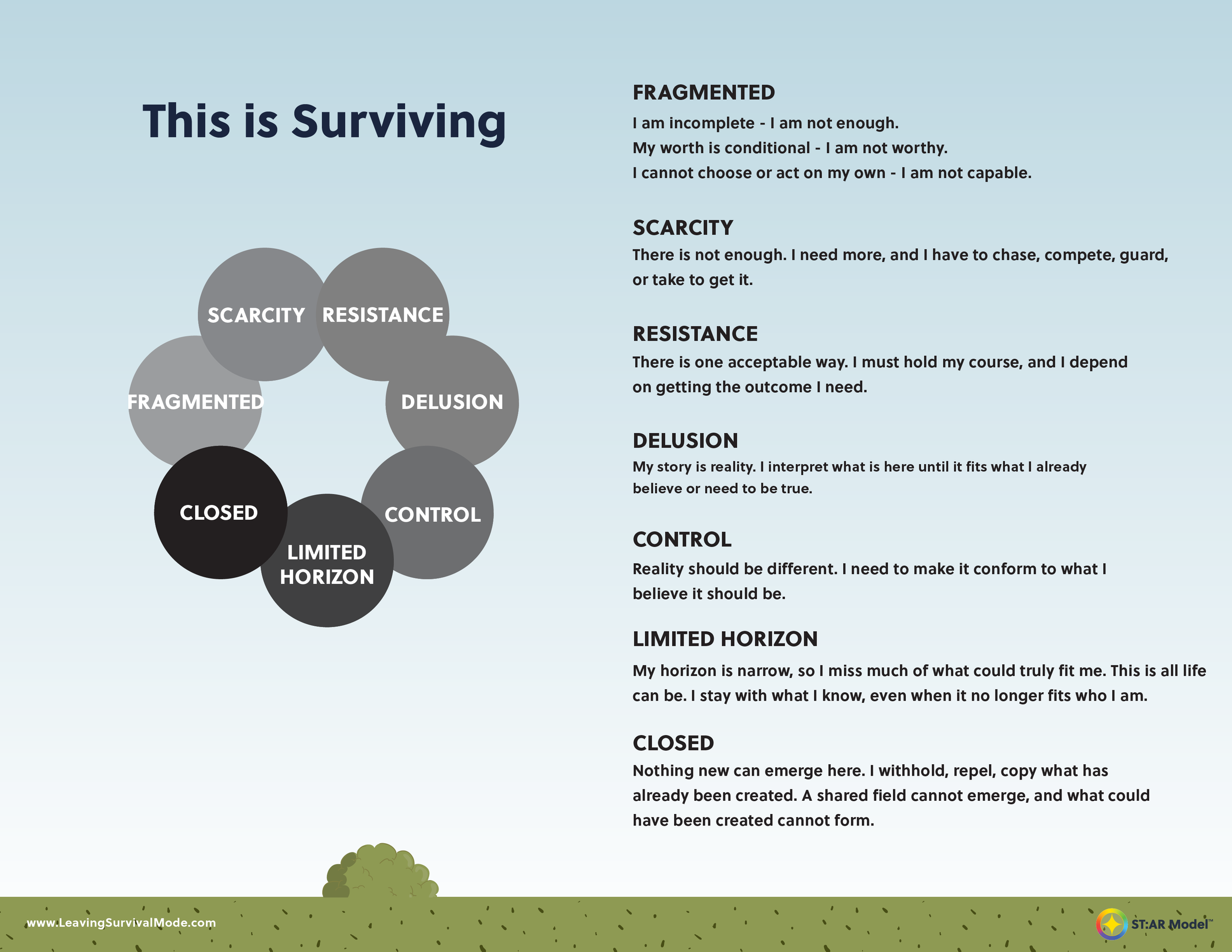
Each Thrive State has a corresponding Survival State:
Whole / Fragmented
Content / Scarcity
Fluidity / Resistance
Clarity / Delusion
Respect / Control
In this course, we will learn these five pairs.
Each pair describes a different organizing distinction.
Whole and Fragmented concern how the self is organized.
Content and Scarcity concern enoughness.
Fluidity and Resistance concern movement.
Clarity and Delusion concern perception of reality.
Respect and Control concern how reality, including realities beyond our own, is met.
The point is not to decide which label belongs to someone.
The point is to understand the structure each map is describing.
ST:AR provides a map. This course teaches you how to read it.
That begins with understanding what the maps are actually showing.