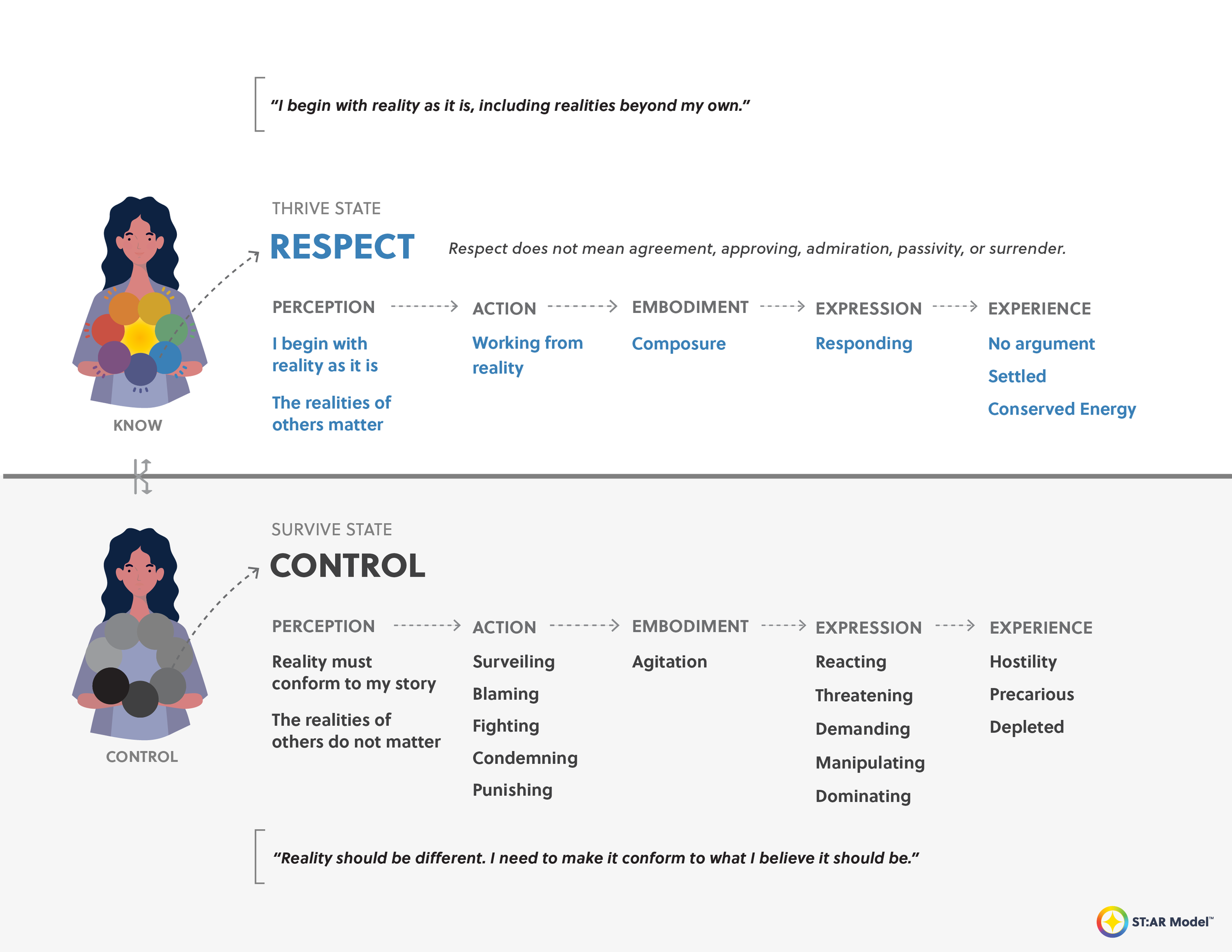
Module 6: Respect / Control
Respect and Control describe two different ways of relating to reality once reality has been encountered.
Clarity asks:
What is actually here?
Respect asks:
Can I begin from what is actually here?
Control begins somewhere else:
Reality should be different, and I need to make it conform to what I believe it should be.
That difference organizes the entire map.
RESPECT
Perception
I begin with reality as it is.
The realities of others matter.
Action
Working from reality
Embodiment
Composure
Expression
Responding
Experience
No argument
Settled
Conserved energy
Respect begins with reality rather than with a demand that reality first become something else.
It does not mean liking what is here.
It does not mean approving of it.
It does not mean agreeing with another person.
It means reality is allowed to count.
CONTROL
Perception
Reality must conform to my story.
The realities of others do not matter.
Action
Surveiling
Blaming
Fighting
Condemning
Punishing
Embodiment
Agitation
Expression
Reacting
Threatening
Demanding
Manipulating
Dominating
Experience
Hostility
Precarious
Depleted
Control begins when reality is not merely unwanted, but treated as something that must be forced into conformity.
The story becomes the standard.
Reality becomes the problem.
Respect Is Not Approval
This distinction is essential.
Respect does not mean:
This is good.
This is acceptable.
I agree.
I will allow this to continue.
I will do nothing.
A person can fully respect reality and still oppose what is happening.
They can leave.
Refuse.
Set a boundary.
Intervene.
Disagree.
Change direction.
Work toward something different.
Respect simply begins with what is actually here rather than with an argument that it should already be otherwise.
The Realities of Others Matter
Respect also includes the recognition that other people have realities of their own.
Their perceptions may differ.
Their wants may differ.
Their choices may differ.
Their limits may differ.
Their interpretation may differ.
Respect does not require agreement with those realities.
It means they remain real even when they conflict with our own.
Control collapses that distinction.
The other person's reality matters only to the extent that it conforms to what the controlling system requires.
Control Is Not Influence
People influence one another constantly.
We ask.
Persuade.
Negotiate.
Teach.
Warn.
Invite.
Challenge.
Set consequences.
Try to change things.
None of that is automatically Control.
Control appears when influence becomes an attempt to override reality rather than work with it.
The distinction is not:
action versus passivity
It is:
working from reality versus requiring reality to submit.
The Central Difference
The entire map can be understood through one contrast:
Respect:
This is what is here. I can begin from here.
Control:
This should not be what is here. I need to make it become something else.
From that difference come composure or agitation, responding or reacting, settledness or precariousness.
Next we look more closely at the foundation of Respect:
Reality as It Is