Module 4: Fluidity / Resistance
Fluidity and Resistance describe two different ways experience can organize around movement.
At the center of the pair is a simple contrast:
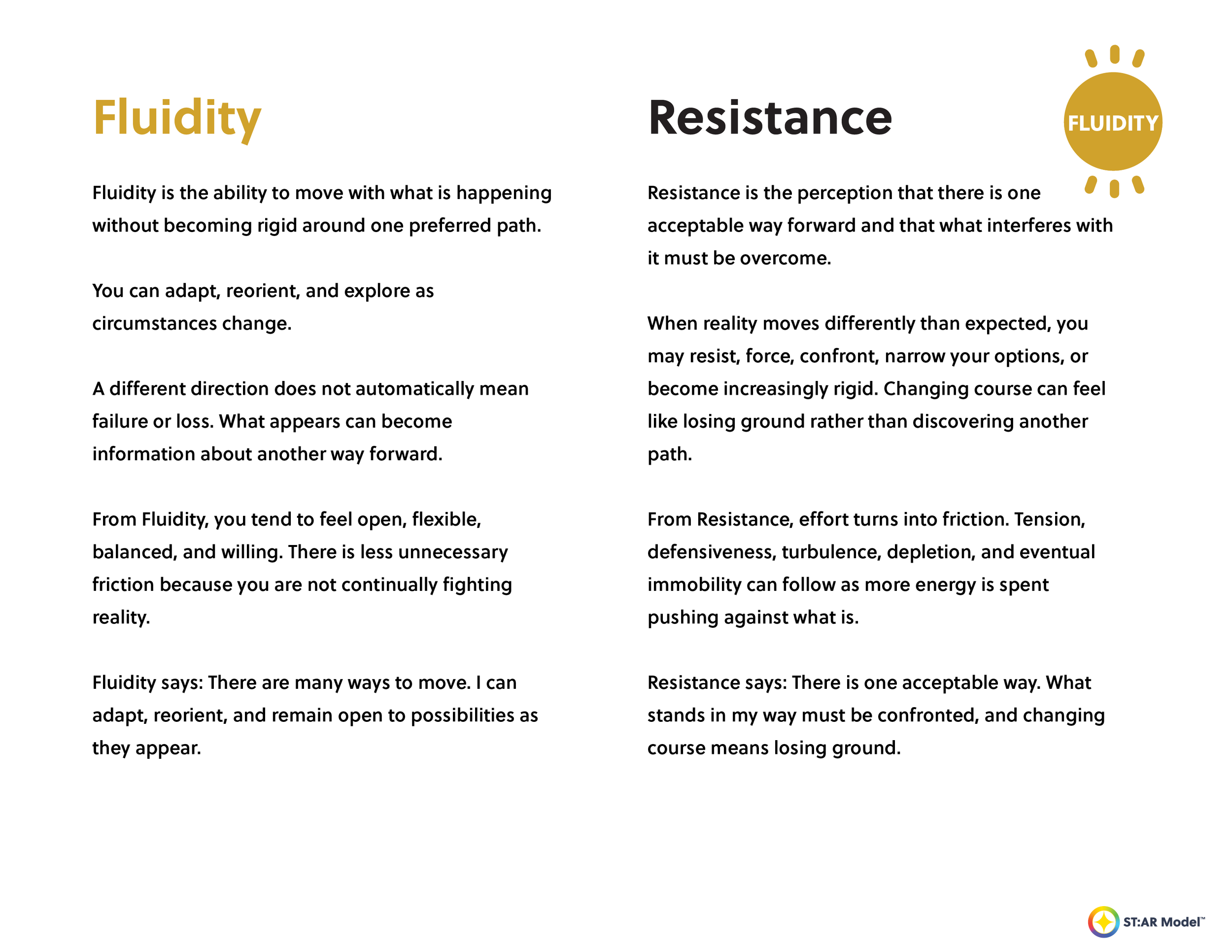
FLUIDITY
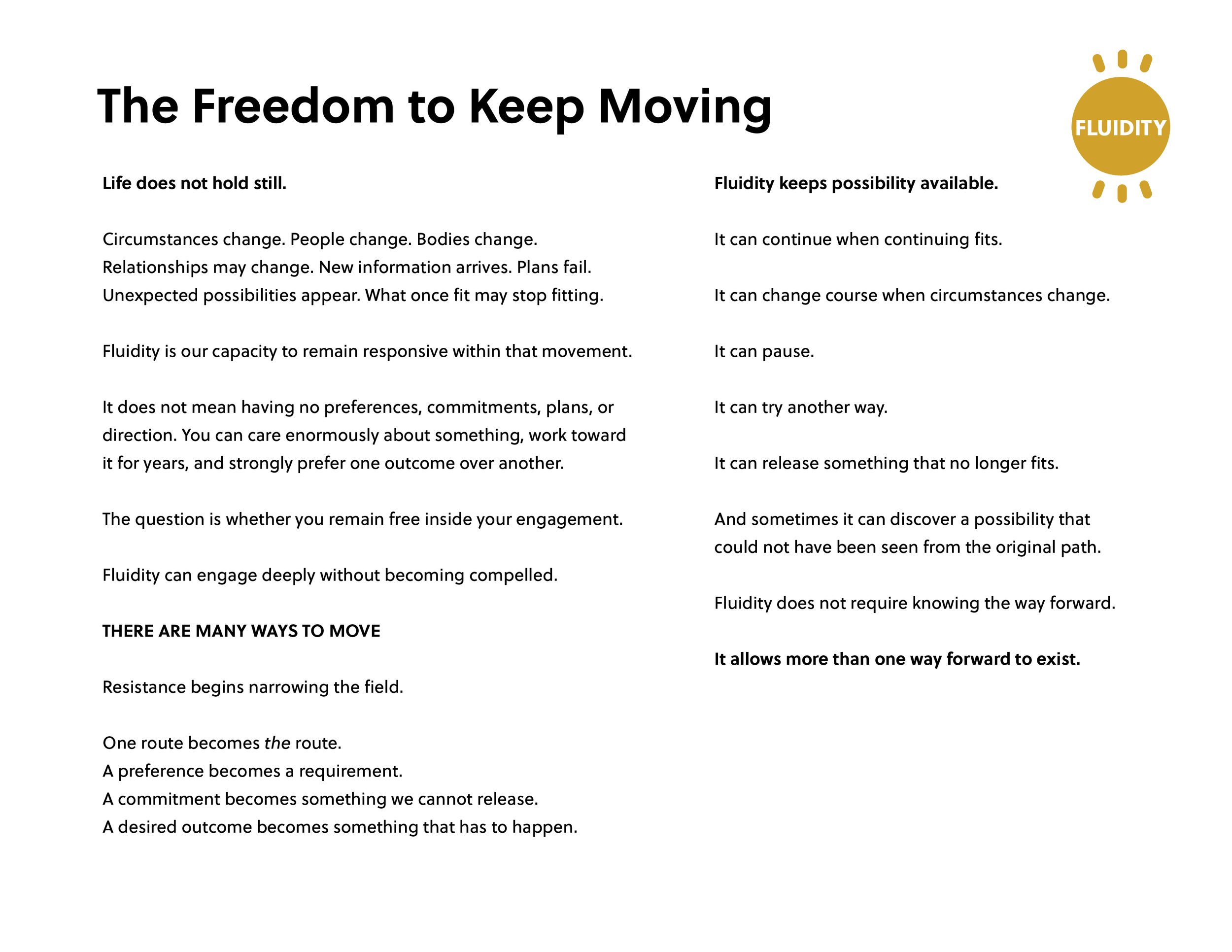
There are many possible ways to move.
Changing course is sometimes the best course.
I can prefer an outcome without depending on it.
RESISTANCE
There is one acceptable way to move.
Changing course is not acceptable.
I depend on a particular outcome.
That difference in perception organizes everything that follows.
FLUIDITY
Perception
There are many possible ways to move.
Changing course is sometimes the best course.
I can prefer an outcome without depending on it.
Action
Adapting
Reorienting
Embodiment
Open
Flexible
Balanced
Willing
Refreshed
Expression
Allowing
Making Room
Moving with What Is
Experience
Ease
Choice
Low friction
Agility
Resilience
Mobility
Fluidity begins with more than one possible way forward.
There may be a preferred direction.
A goal may matter deeply.
A particular outcome may be wanted.
But the system does not depend on reality unfolding in only one acceptable way.
When circumstances change, movement can change with them.
RESISTANCE
Perception
There is one acceptable way to move.
Changing course is not acceptable.
I depend on a particular outcome.
Action
Forcing
Forcing Direction
Embodiment
Defensive
Rigid
Unyielding
Unbalanced
Drained
Expression
Striving
Narrowing
Colliding
Fixating
Experience
Tension
Compulsion
High friction
Turbulence
Fragility
Immobility
Resistance begins when movement becomes organized around one required path or outcome.
Reality may change.
New information may appear.
The original route may stop working.
But if only one direction remains acceptable, movement cannot easily reorganize around what is actually happening.
The system begins pushing against reality rather than moving with it.
Fluidity Is Not Aimlessness
Fluidity does not mean having no direction.
It does not mean giving up whenever something becomes difficult.
It does not mean avoiding commitment.
A person can be highly intentional and still be Fluid.
The distinction is whether direction remains responsive.
There is a difference between:
This matters to me, and I will keep finding ways to move toward it.
and
This must happen in this way.
Resistance Is Not Difficulty
Resistance also does not mean something is hard.
A path may require enormous effort and still be Fluid.
Reality itself can contain friction, limitation, delay, loss, and challenge.
The map is describing unnecessary resistance created by dependence on one acceptable way of moving.
That distinction will become increasingly important as we move through the module.
The Central Difference
The entire map grows from one inversion:
Fluidity:
There are many possible ways to move.
Resistance:
There is one acceptable way.
From there, adapting or forcing, openness or rigidity, allowing or colliding, and ease or friction begin to make sense.
Next we look more closely at the perception underneath both States:
Preference / Dependency