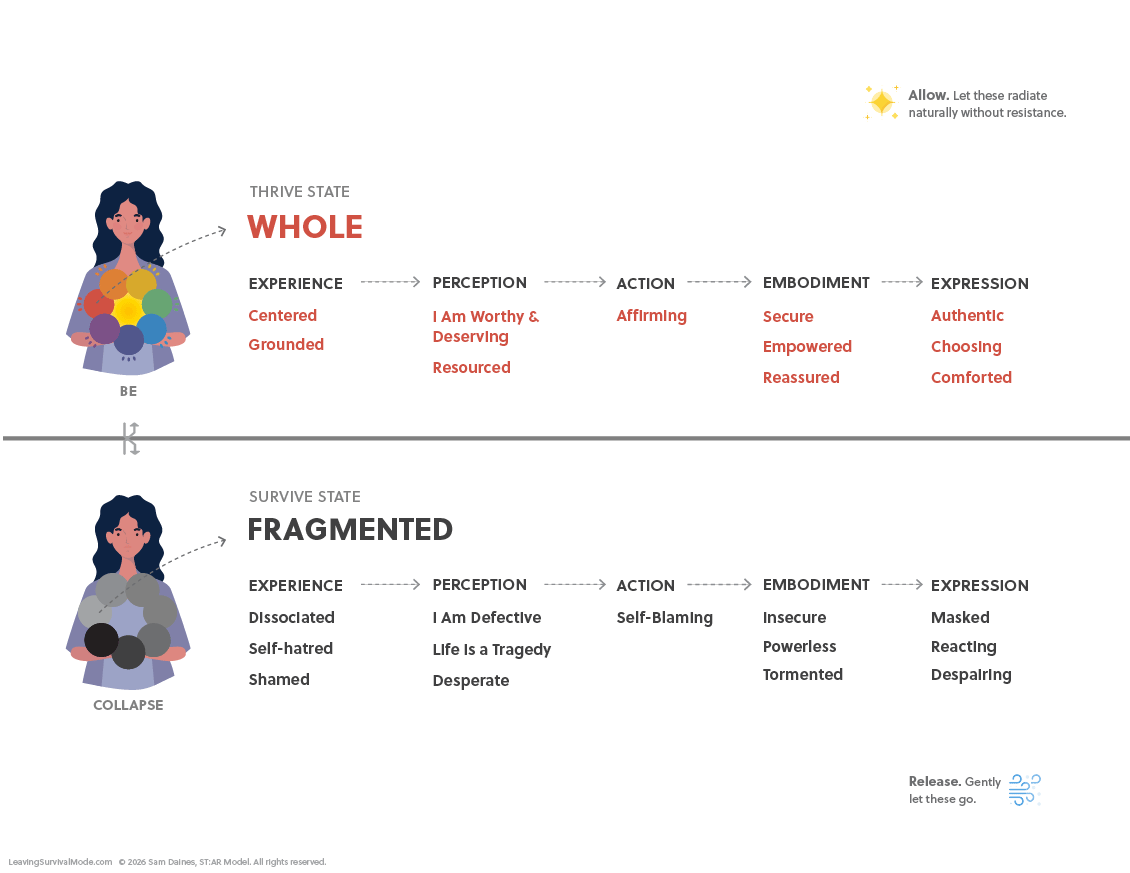
Whole / Fragmented States
Learn to recognize when you’re operating from wholeness and when fragmentation is active.
See how these states show up in your thoughts, reactions, and daily life.
This gives you a clear reference point for what’s actually happening. Without this, everything feels mixed and harder to work with. With it, things start to make sense.
Tools
The state sheet helps you recognize the structure of a survival pattern clearly—how it feels, how it sees, and how it moves through your life.
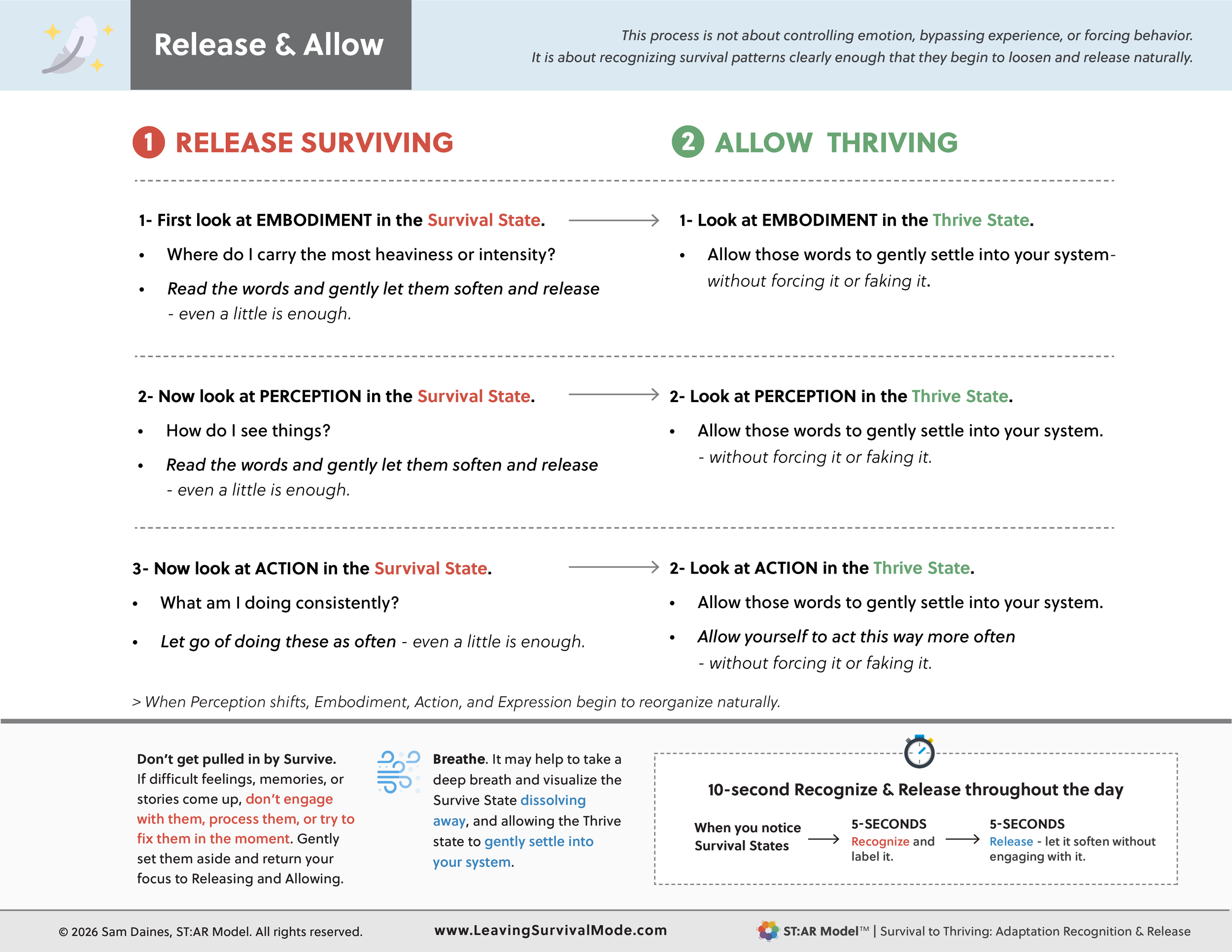
The Release & Allow process is what helps that pattern begin to loosen.
Rather than forcing change through pressure, analysis, or performance, the process works through recognition, softening, and non-engagement.
Over time, this creates space for Thrive States to emerge more naturally.
The two tools are designed to work together: recognize the state, then move gently through the Release & Allow process.
Even small shifts, repeated consistently, begin to reorganize the system.
Focus
Whole / Fragmented States
Most people move through life without realizing that they operate from fundamentally different internal states.
Sometimes they feel clear, grounded, connected, and coherent.
Other times they feel reactive, defensive, collapsed, pressured, performative, emotionally flooded, numb, or internally divided.
Most people assume these shifts simply are who they are.
But they are not.
They are states.
And learning to recognize the difference between wholeness and fragmentation changes almost everything.
What Is a Whole State?
A whole state is a condition of internal coherence.
Your thoughts, emotions, actions, and perception are relatively aligned.
You are not fighting yourself internally.
You are able to:
think more clearly
respond rather than react
stay connected to yourself
tolerate discomfort without collapsing
remain present under pressure
move with less friction
Wholeness does not mean perfection.
It does not mean constant happiness.
It does not mean becoming passive, detached, or endlessly calm.
It simply means:
less internal division.
In a whole state, there is less energy being spent on protection, performance, suppression, avoidance, or fragmentation.
You are more available to reality as it actually is.
What Is a Fragmented State?
A fragmented state occurs when survival patterns begin taking over perception, behavior, or internal experience.
Instead of responding from clarity, you begin reacting from protection.
Fragmentation often feels like:
pressure
urgency
defensiveness
emotional flooding
collapse
confusion
compulsive thinking
performing
controlling
people pleasing
withdrawing
numbness
overexplaining
needing reassurance
losing perspective
Fragmentation is not failure.
It is usually adaptation.
Most fragmented states originally developed to help you survive stress, unpredictability, rejection, conflict, pressure, instability, shame, or emotional overwhelm.
The problem is not that these patterns formed.
The problem is that they often continue operating long after the original conditions are gone.
Fragmentation Changes Perception
One of the most important things to understand is this:
Fragmentation does not only change behavior.
It changes perception.
When fragmented:
neutral situations can feel threatening
small problems can feel enormous
disagreement can feel unsafe
uncertainty can feel unbearable
pressure can feel absolute
other people’s emotions can feel controlling
your own thoughts can feel unquestionably true
This is why fragmented states are difficult to recognize while they are happening.
From inside the state, the experience feels real.
And in many ways, it is real.
The nervous system is genuinely responding as though protection is necessary.
Recognition is not about judging yourself.
It is about learning to notice:
“Something in me has shifted.”
Wholeness Creates Space
One of the clearest signs of wholeness is space.
Not physical space.
Internal space.
A pause between:
stimulus and reaction
feeling and action
pressure and movement
thought and identification
In whole states:
you can observe thoughts without immediately becoming them
emotions move without fully controlling behavior
discomfort becomes more tolerable
perspective widens
options become visible again
You stop feeling trapped inside every emotional movement.
This is where clarity begins.
Fragmentation Narrows Everything
Fragmented states narrow perception.
Attention collapses around:
threat
approval
protection
urgency
control
escape
emotional survival
This narrowing often creates:
black-and-white thinking
compulsive loops
impulsive action
overreaction
emotional exhaustion
relationship friction
shame spirals
identity confusion
The more fragmented a person becomes, the smaller and more reactive their world often feels.
Why Recognition Matters
Most people try to change behavior before recognizing state.
This usually fails.
Because fragmented states reproduce fragmented behavior.
When you can recognize:
“I am fragmented right now.”
something important happens.
You stop fully identifying with the state.
A small amount of space appears.
And that space changes everything.
Recognition itself is stabilizing.
Not because it instantly solves the problem.
But because awareness interrupts automatic movement.
You Do Not Need to Fix Everything Immediately
Many people approach growth as though every uncomfortable state must immediately be repaired.
This often creates more fragmentation.
The goal initially is not perfection.
The goal is recognition.
Can you begin noticing:
when pressure enters?
when clarity leaves?
when urgency takes over?
when performance activates?
when fear begins shaping perception?
when you stop feeling internally grounded?
This alone changes your relationship to yourself.
Real-Life Examples
Whole State
Someone criticizes you.
You feel discomfort.
But you remain connected to yourself.
You are able to:
consider the feedback
stay present
respond thoughtfully
disagree if needed
not collapse internally
Fragmented State
Someone criticizes you.
Immediately:
shame activates
defensiveness rises
urgency appears
identity feels threatened
you overexplain, withdraw, attack, or spiral
The criticism now feels much larger than the actual moment.
Another Example
Whole State
You do not know what comes next in life.
There may still be uncertainty.
But there is enough internal steadiness to tolerate not having immediate answers.
Fragmented State
Uncertainty becomes unbearable.
You compulsively:
search
plan
distract
seek reassurance
force decisions
panic about the future
The nervous system interprets uncertainty as danger.
Fragmentation Is Extremely Common
This work is not about separating “healthy people” from “unhealthy people.”
Everyone experiences fragmentation.
The question is not:
“Do I ever become fragmented?”
The question is:
“Can I recognize it while it is happening?”
That recognition creates the possibility for different movement.
What Helps Move Toward Wholeness?
Wholeness is usually not created through force.
It is often supported through:
recognition
slowing down
reducing internal pressure
truthful observation
rest
boundaries
emotional honesty
grounded environments
stepping out of performance
reducing unnecessary stimulation
tolerating discomfort without immediately reacting
Small shifts matter.
Wholeness is often quieter than people expect.
Many people spend years believing they are fundamentally broken.
But often what they are experiencing is fragmentation.
And fragmentation is not identity.
It is a state.
States can change.
Recognition is where that change begins.
Reflection Questions
What does fragmentation most commonly feel like for you?
What situations tend to pull you out of wholeness most quickly?
What are early signs that fragmentation is beginning?
When do you feel most internally coherent or grounded?
What helps create more internal space in your life?
Use the tools
Start using the Recognize & Allow tool along with the States at the top of this page.
Try asking yourself periodically:
“Am I currently moving from wholeness or fragmentation?”
You may begin recognizing patterns far sooner than you expect.
Q&A
Question ….
Question ….
Question ….
Question ….
Question ….
Question ….
Question ….
Practice: Recognize - Release - Allow
Hypothetical Scenarios
lkjs dflk
lkjs dlkj
lkj sdlkfj
lkj lkj
lkjs d
lksj df
lkjsdf
lkjs df
lksj df
lkjs df
lksj df
lskjd f
lkjs df
lkjs df
lksjd f
lkjs df
lkjs df
lksj df
lksj df
lksj df
ks jdf
lskjd f